Take This Job and….

Wait!
Here are some research-based ways teachers and principals can rejuvenate their passion for their jobs in the new year.
I’ve always thought that educators are some of the luckiest people in the world.

I’ve always thought that educators are some of the luckiest people in the world.
When I say the word mindfulness to a group of educators and ask what the word signifies I get several definitions. The term is ancient and not surprisingly has taken on many definitions over time. This is a paradox of language: As a word becomes popular, its original meaning can become vague. Although the movement of mindfulness into mainstream secular society is relatively recent, we already see some instances where its meaning has become blurred. That is why I’ll begin this introduction to mindfulness for teachers and their students by describing what I mean when I talk about mindf
Within the virtually exploding field of mindfulness, perhaps no facet is growing faster and spreading wider than that of teaching mindfulness to the youth of our society. Imagine the vast potential of transforming this generation of children into a future generation grounded in a practice that promotes stability and composure, wellness and healthy relationships, and enhanced cognitive function. This movement is on an unprecedented ascendant path within education, clinical practice and research.
Well of course that makes sense! We leave work and drive too fast to get home so we can finally relax. Between patients we scribble notes in the file, run to the bathroom, and make a phone call while slurping caffeine so that after the next patient we can catch our breath. We inhale lunch without looking at it while we order holiday gifts on online because we don’t want to waste time just eating.
If you follow workplace mindfulness in the news, you’ve had quite a bit of reading material in the last few months. Businesses of all types have embraced the fact that the wellbeing of their employees improves the health of the company.
 With the proliferation of mindfulness and Mindfulness-Based Interventions, there is increasing demand for foundational and advanced training for teachers of these so-called "MBIs".
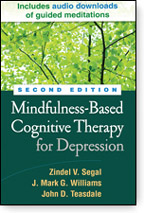 Few psychological interventions have engendered so much promise and delivered on that promise with such impressive clinical outcomes and research findings as Mindfulness-Based Cognitive Therapy (MBCT).
A Message From Allan Goldstein
Associate Director
UCSD Center for Mindfulness
Dear Friends and Colleagues,
When I first read Daniel Goleman's call in Emotional Intelligence for mindfulness to be taught in schools I could not have imagined that I would be sending a personal message asking for your support for a conference that brings together the wonderful growing community of people now engaged in that work.
You shouldn’t kick yourself when you’re down . . .
. . . but sometimes it’s hard not to. Even if we’re compassionate toward others, we can still be our own worst critics. Mindfulness meditation really works. And self-compassion is one of its key benefits.
Kristin Neff, PhD, from the University of Texas, Austin, and Christopher Germer, PhD, from Harvard Medical School, wanted to find out whether self-compassion could be developed through training.
One day when my son was three, I walked into my bedroom to find him seated on the floor cutting thin green foam that he had pealed off some clothing hangers. I asked “J, honey, what are you doing?” He replied “I am cutting slack.” If a three year old can cut himself some slack then perhaps we mothers can do it too.
Most of us say “ I just want my kids to be happy….” However often, we so desperately want our kids to be happy that we make ourselves and our children a bit crazy in the process.

Scroll to Top